Modernizing Legacy Systems with Applied AI
Tech in Motion Leadership Panel • Chicago
March 5, 2026
Panel Discussion
Tech Leaders & Executives
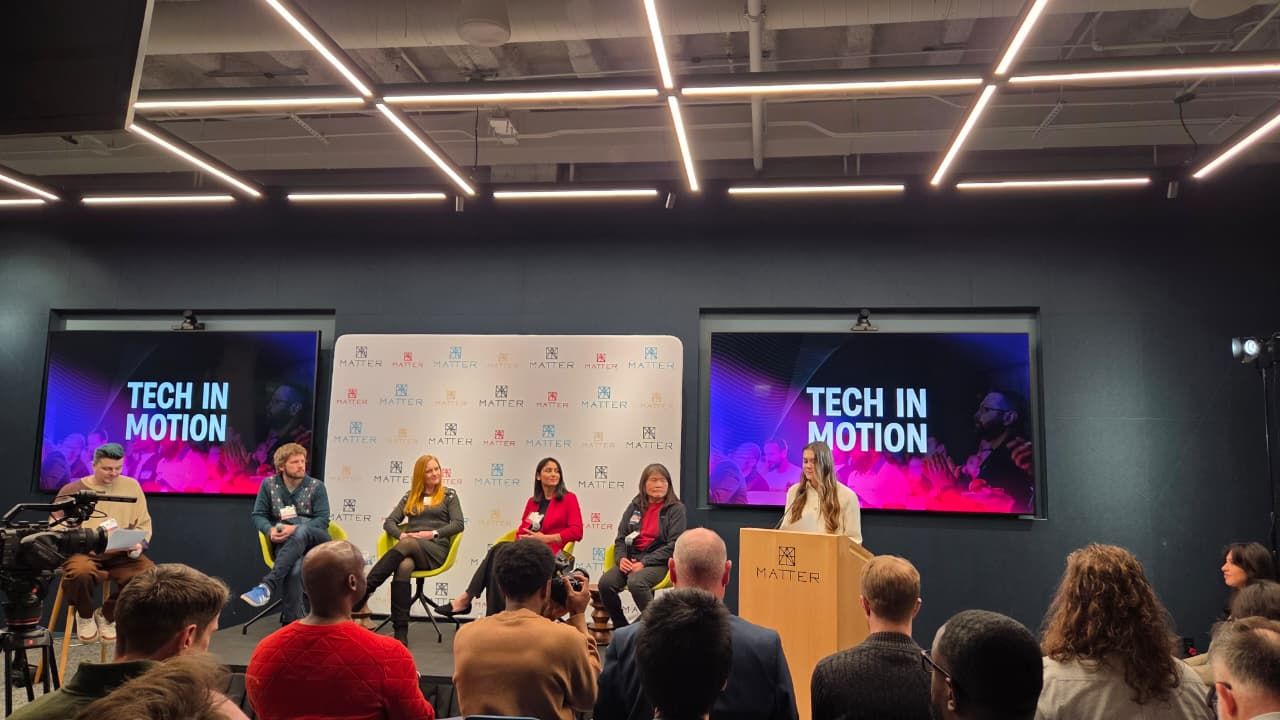
A leadership panel examining how organizations in legacy environments are deploying AI to drive real, measurable transformation and what it takes to build, scale, and operate these systems responsibly.
Key Themes
- •AI in legacy environments
- •Modernizing aging systems
- •Compliance and security in AI adoption
- •Governance and risk management
- •Hybrid skill sets and evolving roles
- •Operational resilience
The Panel
I joined a leadership panel at MATTER Chicago for Tech in Motion, alongside leaders from Grainger, Attune, The AI Collective, and Secret Sauce. The topic was AI in legacy industries, and the room was full of people who actually live this problem. Not theorists. Practitioners. People who know what it feels like to pitch a modern solution to a system that was built before most of the team was hired.
What I appreciated most was the honesty. Nobody pretended this was easy. Nobody waved away the organizational friction. The conversation stayed grounded in what's real: the constraints, the politics, the technical debt, and the moments where AI genuinely moves the needle.
What I Brought to the Conversation
My perspective on this panel came from a specific place: the intersection of behavioral science and engineering systems. I've spent years studying how teams miss critical signals under complexity. Legacy environments amplify that problem. The systems are opaque. The institutional knowledge is unevenly distributed. The feedback loops between intent and behavior have often decayed to the point where nobody can articulate what "normal" looks like anymore.
That's where I focused. Not on the AI itself, but on the decision-making layer underneath it. When you're deploying AI into a legacy environment, the hardest question isn't technical. It's whether the organization can actually observe the difference between what the system is supposed to do and what it's doing now. Without that baseline, you're automating on top of drift. And drift compounds.
I also talked about the human side of modernization. Change management in legacy environments isn't a checkbox. It's the whole game. The teams that succeed are the ones that treat AI adoption as a cross-functional effort, not an engineering project with a stakeholder update attached. Compliance, security, governance, bias mitigation — these aren't afterthoughts. They're the constraints that shape what's actually possible.
What the Panel Covered
The broader conversation touched on territory I care about but from angles I don't always get to hear. Nathan Frank from Grainger talked about what it looks like to build and operate ML platforms inside a company with deep operational history. Ishu Jaswal from Attune brought the data science lens — how you make AI work when the data itself carries decades of legacy assumptions. Mary Grygleski from The AI Collective offered a global perspective on where AI adoption is accelerating and where it's stalling, and why the gap matters.
Across the panel, a few themes kept surfacing. Regulated environments demand a different kind of rigor. You can't move fast and break things when breaking things means compliance violations or patient safety risks. The organizations getting real ROI from AI aren't chasing moonshots. They're finding specific, high-friction seams in existing systems and applying targeted solutions that deliver measurable outcomes.
The workforce conversation was particularly interesting. AI isn't just creating new tools. It's creating new roles. The people who will matter most in legacy modernization aren't purely technical or purely strategic. They're the ones who can bridge both — who understand the systems deeply enough to know where AI fits and the business well enough to know why it matters.
What Stayed With Me
The thing I keep coming back to is how much of this work is about observation. Legacy systems don't fail because nobody cares. They fail because the gap between belief and reality widens so gradually that it becomes invisible. AI can help close that gap, but only if you're honest about how wide it is.
The organizations that will win this transition are the ones willing to measure what they've been ignoring. Not just the technical metrics, but the behavioral ones. How decisions get made. Where information gets lost. What assumptions have calcified into architecture. That's the real modernization work. The AI is just the tool.