GenAI & AI Use Cases: Speed, Specificity, and Strategic Thinking
Women in Tech Dinner • Chicago
May 1, 2025
Facilitated Discussion
Women in tech leaders and practitioners
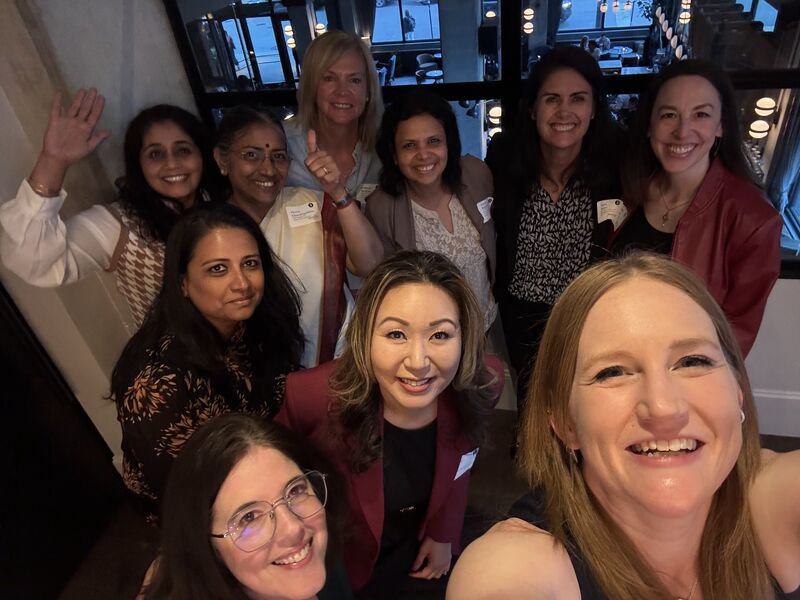
A moderated table discussion exploring GenAI applications, the importance of speed and specificity in AI projects, and how AI creates space for deeper strategic thinking.
Key Themes
- •GenAI applications
- •AI strategy
- •Women in tech
- •Practical AI implementation
The Conversation
I moderated a table at The Hoxton in Chicago, hosted by the Innovative Executives League. The room was full of women leaders wrestling with real questions: Which AI projects actually matter? How do we move fast without losing our way? How do we keep humans in the loop when the technology is moving this quickly? What struck me was how grounded everyone was. No one was chasing AI for the sake of it. Everyone was thinking strategically about what would actually move the needle for their organizations.
The Three-month Rule
Here's what came up repeatedly: any AI initiative that stretches beyond three months risks becoming obsolete. The pace of change is just too fast. You can't afford to spend six months building something that might be irrelevant by the time you launch it. So pick something specific. Something with clear impact. Solve it. Learn from it. Move on. The projects that fail are the ones that promise to "transform the organization." Those become sunk costs. The ones that win are the ones that solve a real problem in a real timeframe. The key is alignment. AI should improve what you're already doing well. It shouldn't dictate your strategy. If you're using AI because it's trendy, you're doing it wrong.
Automation Without Losing the Human
AI is incredible at automating the tedious stuff. The repetitive work that drains your team's energy. When you automate that, people can focus on what they actually do best — thinking, deciding, creating. But you can't remove humans from the equation. Not in healthcare. Not in customer service. Not anywhere that context and judgment matter. The best systems don't try to hide the automation. They keep humans in the loop at the right moments. They avoid those frustrating loops where you're stuck talking to a bot that can't help you. They know when to hand off to a person who can actually understand what's happening. That's what builds trust. That's what creates an experience that feels human, not like you're fighting a system.
What Developers are Becoming
The shift from writing code to guiding AI systems is real. Developers aren't going away. They're evolving. They're becoming the people who understand systems deeply enough to know when something's wrong, when the AI is hallucinating, when the output doesn't make sense. That oversight is critical. Especially in security, where AI can spot patterns and anomalies at scale in ways humans can't. But adoption won't be uniform. Different industries will move at different speeds. Different customer segments will have different comfort levels. Companies that account for that variance will win. The ones that don't will struggle.
The Real Opportunity
Here's what I found most compelling: when AI handles the labor-intensive work, humans can focus on strategy. On the thinking that actually moves the needle. On the decisions that matter. That's the real win. Not replacing people. Freeing them to do the work only they can do. It's tempting to chase AI for novelty. But the companies that win are the ones that think strategically about where AI fits into their business. They build trust through human validation. They move fast but stay focused. They see AI as a tool to enable human capability, not replace it. That mindset will shape the workforce and the customer experiences we build going forward.